Why Agile Breaks in an AI World
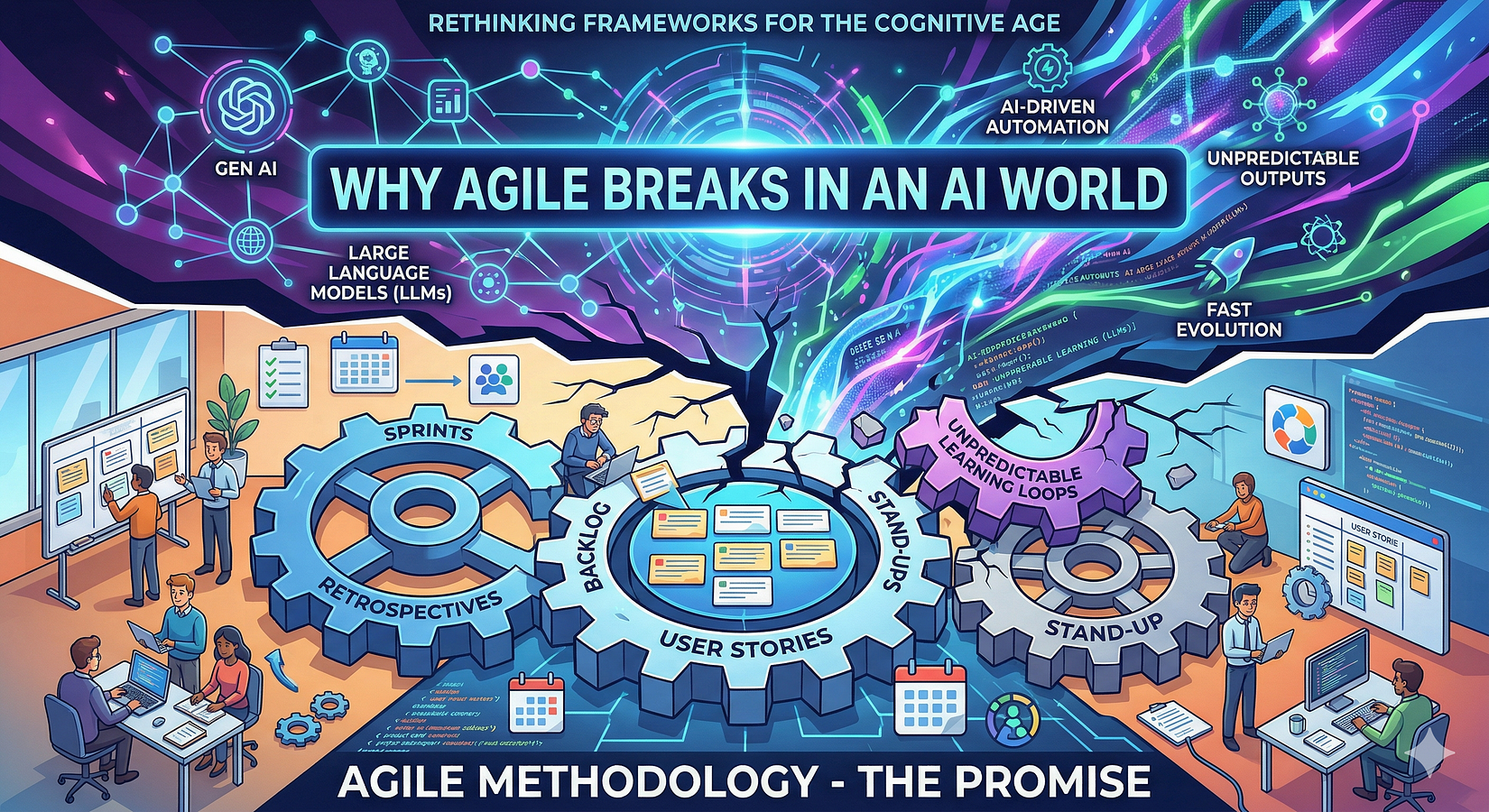
For years, Agile was treated as the answer to software development.
Standups.
Sprints.
Story points.
Velocity.
It gave teams structure in a world where building software was slow, expensive, and uncertain.
But that world no longer exists.
AI has changed the economics of software development — and Agile hasn’t caught up.
Agile Was Built for a Different Problem
Agile emerged in a time when:
- Writing code was slow
- Changing direction was expensive
- Planning too far ahead was risky
So we adapted.
We broke work into:
- small tasks
- short iterations
- continuous feedback loops
It made sense.
Because the bottleneck was production.
Getting code written was the hardest part.
AI Eliminates the Old Bottleneck
Today, tools like GitHub Copilot can generate:
- entire features
- APIs
- UI components
- test scaffolding
…in seconds.
Suddenly, writing code is no longer the constraint.
So what happens to a methodology designed to optimize… writing code?
It starts to crack.
The “Ceremony Economy”
Most Agile teams today are stuck in what I call:
The Ceremony Economy
A cycle of:
- standups to talk about work
- sprint planning to estimate work
- retrospectives to reflect on work
- backlog grooming to organize work
But here’s the uncomfortable truth:
These ceremonies optimize the flow of tasks — not the correctness of systems.
They measure:
- activity
- progress
- effort
They do not measure:
- whether the system behaves correctly
- whether constraints are enforced
- whether the architecture is sound
The Illusion of Progress
In an AI world, teams can now:
- generate features faster than ever
- close tickets rapidly
- increase velocity dramatically
On paper, everything looks great.
But under the surface:
- inconsistencies grow
- assumptions pile up
- constraints are violated
- technical debt explodes
This is the paradox:
The faster you move, the more fragile your system becomes.
Agile has no mechanism to detect this.
The Real Bottleneck Has Moved
The problem is no longer:
“How fast can we build this?”
The problem is now:
“Are we building the right thing, in the right way, with the right constraints?”
AI amplifies ambiguity.
If your requirements are unclear:
- AI will guess
- and it will guess confidently
Multiply that across a system, and you get:
A fast-moving, well-organized mess.
Why User Stories Start to Fail
User stories were designed to capture intent:
“As a user, I want…”
But in practice, they’ve become:
- vague
- incomplete
- open to interpretation
Humans could compensate for that ambiguity.
AI cannot.
It fills in the gaps with:
- assumptions
- patterns
- approximations
Which means:
The weaker the story, the more unpredictable the result.
The Core Mismatch
Agile is:
- task-centric
- optimized for human execution
- tolerant of ambiguity
AI-native development is:
- spec-centric
- optimized for machine execution
- intolerant of ambiguity
That’s the mismatch.
Agile says:
“We’ll figure it out as we go.”
AI requires:
“Define it clearly, or I will guess.”
What Replaces Agile?
Not more process.
Not more ceremonies.
Something simpler — and stricter.
Intent-Driven Development
Instead of managing tasks, you manage truth.
You define:
- what must always be true
- what must never happen
- what constraints cannot be violated
For example:
- Payment must be authorized before order confirmation
- Transaction IDs must be globally unique
- API latency must stay under 200ms
These are not tasks.
They are non-negotiable system rules.
From Velocity to Veracity
Agile measures:
- velocity
- burndown
- throughput
But those metrics don’t tell you if your system is correct.
In an AI world, the metrics must change:
- Intent Coverage — how much of your system is governed by clear rules
- Intent Compliance — are those rules being enforced
- Intent Drift — where reality diverges from expectations
This is the shift:
From tracking work
To validating truth
The Teams That Will Win
The teams that succeed in the AI era will not be the ones who:
- run the best standups
- estimate the most accurately
- close the most tickets
They will be the ones who:
- define intent clearly
- enforce constraints consistently
- design systems AI can reliably extend
Final Thought
Agile didn’t fail.
It solved the problem it was designed for.
But that problem is gone.
And if we keep applying old solutions to new realities, we get:
Faster teams… building weaker systems.
AI didn’t break Agile.
It revealed its limits.

%20built%20with%20Blazor.%20The%20scene%20features%20a%20dynamic%20web%20app%20running%20o.webp)

Comments
Post a Comment